
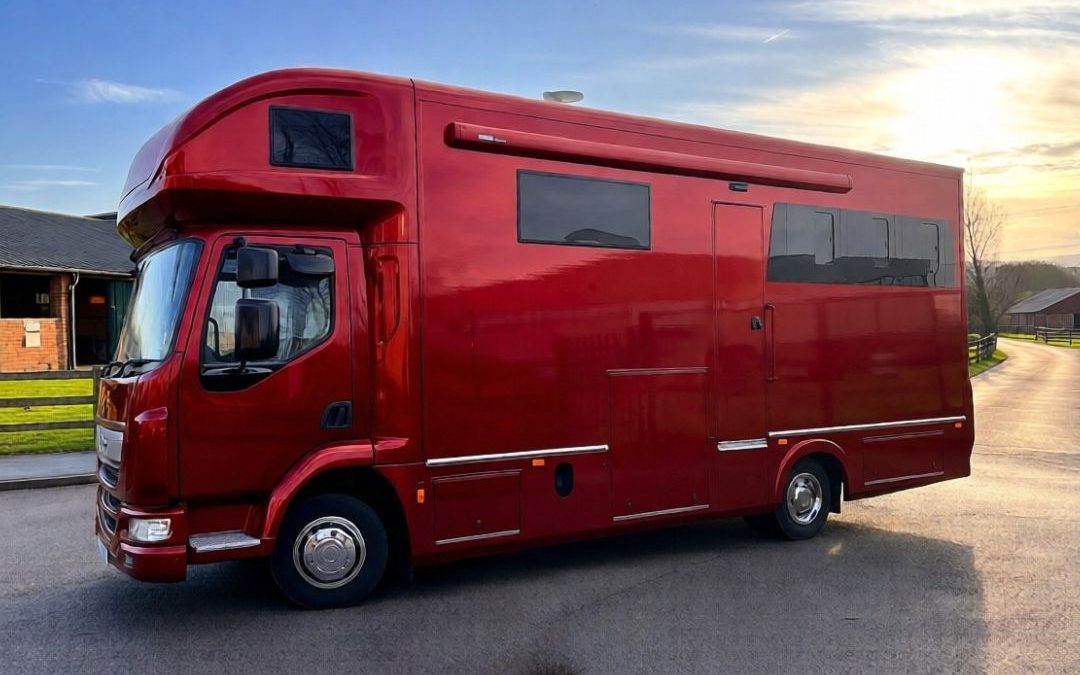
For the dedicated horse owner in Britain, the 7.5 tonne horsebox occupies a special place. It’s the largest vehicle you can drive without a full HGV licence, yet it offers far more space, payload, and luxury than the popular 3.5-tonne alternatives. It is, in the truest sense, the sweet spot — a mobile home for your horses, your tack, and quite often yourself.
Whether you’re a competition rider travelling to county shows, a professional event rider needing overnight accommodation at venues, or simply someone with two large warmbloods to move safely, this guide covers everything the UK market has to offer.
What exactley is a 7.5 tonne horsebox?
First, a clarification on terminology. In the UK, “horsebox” and “horse lorry” are often used interchangeably. Strictly speaking, a horsebox is a self-contained vehicle — the engine, driver’s cab, and horse transport area are all built on a single chassis. Think of it like a motorhome, but designed around equine passengers.
A horsebox trailer, by contrast, is a separate unit you tow behind a car or SUV. When people discuss 7.5-tonne horseboxes, they almost always mean the self-contained lorry — a proper coach-built vehicle with its own drivetrain.
The “7.5 tonne” figure refers to the vehicle’s Maximum Authorised Mass (MAM) — the maximum total weight of the vehicle when fully loaded, including horses, riders, tack, water, fuel and any living accommodation equipment. This is the plated figure, set by the manufacturer and DVSA, and it is the number that governs your licence category, insurance, and legal obligations.
|
At a Glance — The 7.5 tonne Horsebox |
|
|
Maximum legal weight (MAM) |
7,500 kg |
|
Typical unladen weight |
4,000 – 6,000 kg |
|
Typical payload |
2,000 – 3,000 kg |
|
Horse capacity |
2–3 horses (size dependent) |
|
Overall length range |
20ft (compact) to 28ft (large spec) |
|
Required licence |
Category C1 |
|
Speed limiter required? |
Yes — set to 56mph |
Understanding Payload: The Numbers That Really Matter
Here’s where many buyers come unstuck. You cannot simply look at the 7,500 kg figure and assume you have that much capacity to fill with horses and kit. The payload is what’s left after you subtract the vehicle’s unladen weight from its MAM.
A well-specified 7.5-tonne horsebox typically offers a payload of between 2,000 and 3,000 kg. But be warned: heavy living accommodation, water tanks, generators, and extra storage all eat into that figure. Two large warmbloods at 650 kg each, plus tack, hay, water and your passenger, can easily total 2,000 kg or more.
Payload Warning
Overloading is not a grey area. The DVSA carries out roadside checks, and penalties are significant. Ignorance is not a legal defence. If in doubt, visit a public weighbridge — both unladen and loaded — before you commit to any journey.
The Licence Question: What do you actually Need?
This is probably the most-asked question in the horsebox world, and the rules are genuinely a little complicated thanks to the 1997 watershed date in UK driving law.
|
B Standard car licence Covers up to 3,500 kg MAM only. Not sufficient for any 7.5t lorry. |
★ YOU NEED THIS C1 The correct licence For vehicles between 3,500 and 7,500 kg MAM. Requires theory and practical test beyond Cat B. |
C1+E With trailer Needed to tow a trailer behind your 7.5t horsebox, up to 12t combined MAM. |
The pre-1997 “grandfather rights” exception
If you passed your car driving test before 1 January 1997, your Category B licence almost certainly already includes C1 entitlement up to 7.5 tonnes. This means you can legally drive a 7.5-tonne horsebox for private use without taking any additional test. Always check your physical licence — the C1 entitlement should be listed explicitly.
Tip: Even if you have grandfather rights, taking a short familiarisation course before driving a 7.5t lorry is strongly recommended. Braking distances, cornering, and reversing behaviour are fundamentally different from a car or 3.5t van.
Commercial use and Driver CPC
If you drive your 7.5t horsebox solely for private use — your own horses, no payment, no commercial purpose — you do not need a Driver CPC (Certificate of Professional Competence). The moment you accept payment for transporting someone else’s horses, however, the commercial rules apply. Professional horsebox drivers must hold a valid Driver CPC, and failure to produce one when required carries a fine of up to £1,000.
Tachographs and drivers’ hours
For privately-used 7.5-tonne horseboxes, drivers’ hours regulations do not apply. However, all horseboxes over 3.5 tonnes require a speed limiter set to 56 mph. Vehicles over 7.5 tonnes are subject to full tachograph and drivers’ hours rules regardless of use — another reason the 7.5t category is so popular with private owners.
Popular Chassis Used in UK 7.5t Builds
The coach-built body — the horse area, living quarters and exterior shell — is typically built upon a separate lorry chassis. The choice of chassis significantly affects drivability, reliability, and running costs.
|
Chassis |
Notes |
|
Iveco Eurocargo / Daily |
The UK’s most popular 7.5t horsebox chassis. Reliable, parts widely available, good cab comfort. Automatic versions increasingly common. |
|
Mercedes-Benz Atego |
Premium feel, excellent cab quality, strong resale value. Often found in higher-specification builds. |
|
DAF LF |
Robust and practical. Tilt-cab design popular with grooms for engine access. |
|
MAN TGL |
Smooth-driving with good torque. Less common but well respected. |
What Does a 7.5t Horsebox Cost?
Budget expectations need to be realistic. Used 7.5t horse lorries typically start from around £15,000 for older models in basic condition. Vehicles from the 2015–2020 period with good specification and history commonly sell for £35,000–£65,000. New or near-new luxury coach built can reach £80,000 to £100,000 or more.
|
Approximate Price Ranges (UK Market, 2025–26) |
|
|
Older used (pre-2010, basic spec) |
£12,000 – £25,000 |
|
Mid-range used (2010–2018) |
£25,000 – £55,000 |
|
Recent used (2018–2023, full spec) |
£50,000 – £80,000 |
|
New build, luxury specification |
£80,000 – £110,000+ |
Running costs should also factor into your budget. Road tax for a 7.5t lorry is notably higher than for a car. Specialist horsebox insurance is required. Annual MOT testing is mandatory, and diesel fuel consumption on a fully-laden 7.5t lorry averages around 12–18 miles per gallon depending on the engine and conditions.
Is a 7.5 Tonne Horsebox Right for You?
The honest answer is: it depends on how you use your horses and how seriously you compete or travel. If you’re making occasional local trips with one or two horses, a quality 3.5-tonne lorry or even a well-matched trailer and tow vehicle may serve you perfectly well. The 7.5t lorry earns its keep for those who travel long distances regularly, attend multi-day events, need to carry three horses, or want the comfort and independence of full on-board accommodation.
Once you’ve driven one — particularly a well-maintained, modern example with a smooth automatic gearbox and a properly specified living area — it’s very difficult to go back.
Quick Buyer’s Checklist
- Check V5C & VIN plate
- Full MOT & service history
- Inspect ramp mechanism
- Check floor and chassis for rot/rust
- Weigh at a public weighbridge (unladen and laden)
- Verify payload suits your horses
- Confirm your licence entitlement
- Get an independent pre-purchase inspection
Speed Limits for 7.5t Horseboxes (UK)
|
Road type |
Speed limit |
|
Built-up areas |
30 mph |
|
Single carriageways |
50 mph |
|
Dual carriageways |
60 mph |
|
Motorways |
60 mph |
|
Speed limiter setting |
56 mph |
This guide is intended as a general reference for UK horse owners. Driving licence requirements, regulations, and pricing change over time — always verify current rules with the DVLA and DVSA before purchasing or driving a horsebox. Weight and payload figures are illustrative; always confirm the specifics of any individual vehicle.
Free Horsebox Advice
If you need any help or advice from the Chaigley Team

Chaigley horseboxes
Unit 1 Deveron Mill, Meadow Street, Great Harwood, Lancashire BB6 7EJ
Opening Hours
M-F: 8am - 6pm
chaigleyhorseboxes@gmail.com
Phone
07977 334928 or 07974 184934
Chaigley Leisure
Chaigley Campervans
Campervans | Motorhomes